Complete Guide to AI Image to Prompt Conversion: How to Reverse-Engineer Any Reference Photo
Replicating a compelling visual aesthetic from a reference image has historically been one of generative AI's greatest bottlenecks. When creators look at a striking photograph: such as a golden-hour street portrait, an editorial fashion lookbook shot, or a moody film still: standard natural language descriptions frequently fall short. Asking an AI model to generate "a cool stylish guy on a city street at sunset" produces generic, plastic-looking outputs lacking the camera physics, lens curvature, lighting ratios, and color grading that made the original image memorable.
Modern diffusion architectures like Midjourney v6.1, FLUX.1 Pro, and ChatGPT (DALL-E 3) respond most accurately when prompts are structured with photographic rigor. Instead of subjective adjectives, these models rely on objective physical parameters: sensor formats, focal lengths, aperture depths, light quality (diffuse vs specular), and color harmonies.
1. The Four Forensic Layers of Photographic Decomposition
Our in-browser conversion engine analyzes four distinct optical dimensions of an image to reverse-engineer prompts that reproduce the underlying aesthetic:
Extracts the top five dominant color clusters, calculates color temperature (Kelvin warmth vs cool cast), and isolates ambient color spill to provide exact color grading descriptors.
Evaluates tonal distribution across highlights, midtones, and shadows. Identifies lighting direction (rim light, chiaroscuro key, soft overcast bounce, or hard tungsten spotlight).
Infers the focal length and depth of field: 85mm f/1.4 prime lens for creamy background bokeh, 35mm f/1.2 for environmental street shots, or 100mm medium format for crisp product clarity.
Translates optical findings into native syntax for your chosen generator: parameter flags (--style raw, --v 6.1, --ar 3:4) for Midjourney, micro-texture cues for FLUX.1, or narrative framing for ChatGPT.
2. Step-by-Step: How to Turn Any Photo into an Accurate Prompt
Follow this calibrated four-step workflow to generate high-fidelity prompts from any photo:
- Upload Your Reference Photo: Drag and drop your image into the dropzone above or click Select Photo. High-resolution images with distinctive lighting and color contrast yield the most accurate forensic breakdowns.
- Inspect the Extracted Palette & Camera Rig: Review the five dominant color chips. Click any swatch to copy its hex code for reference. Check the detected lighting setup (e.g., Warm Golden Hour Sunset or Neon Twilight) and optical specs.
- Select Your Target Model Engine: Switch between Midjourney v6.1, FLUX.1 Pro, and ChatGPT using the segmented tabs. Each model receives an architecture-specific prompt formatted for its native embedding space.
- Fine-Tune Aesthetic Nuance: Use the aesthetic nuance selector to bias the output toward Cinematic 35mm Film Still, Editorial Lookbook, Urban Streetwear, or Anime Illustration.
- Copy & Launch: Click Copy Master Prompt, or use the direct test buttons to immediately open ChatGPT, Gemini, or Grok with your synthesized prompt pre-loaded.
3. Comparing Model Syntax: Midjourney vs FLUX.1 vs ChatGPT
Each AI generation model interprets text tokens differently. Here is how our studio structures prompt formulas across the major architectures:
Midjourney excels with comma-separated descriptor clusters that specify physical camera equipment and aspect ratios. The inclusion of --style raw prevents the model from adding unwanted hyper-stylized smoothing, preserving genuine skin pores and natural grain.
Black Forest Labs' FLUX.1 Pro features exceptional natural language understanding and high-frequency textural resolution. Prompts are constructed as structured descriptive sentences emphasizing fabric draping, micro-blemishes, and optical color grading.
ChatGPT's internal prompt rewriter performs best when provided with direct directive commands instructing it to avoid artificial digital smoothing while emphasizing genuine photographic optics and natural lighting depth.
4. Photographic Prompt Formula Reference Library
Below are tested prompt formulas reverse-engineered from benchmark photography styles, calibrated for instant copy-pasting:
5. How In Browser Optical Inspection Translates Pixels Into Prompt Tokens
When a commercial photographer studies a reference frame before recreating its lighting in a studio, they never start by naming random adjectives. Instead, they measure four concrete physical observables: highlight to shadow contrast ratio, dominant Kelvin color temperature, focal length perspective compression, and surface specular behavior. Our browser based Image to Prompt Studio applies that exact photographic workflow directly on an HTML5 canvas inside your local device memory without uploading private client images to external cloud storage.
During inspection, pixel luminance histograms reveal whether a scene relies on low key chiaroscuro directional light, balanced studio softbox fill, or high key overcast daylight. Simultaneously, chromatic clustering isolates the five primary hexadecimal swatches that establish mood harmony, such as warm amber skin highlights paired against cool slate architectural shadows. Aspect geometry determines whether the original composition uses vertical three by four portrait framing, square editorial balance, or wide anamorphic cinema proportions.
6. Adapting Extracted Formulas Across Midjourney, FLUX, and ChatGPT
Once you extract a structured prompt from a reference photograph, minor model specific adjustments unlock dramatically higher consistency. Midjourney v6.1 responds strongly to trailing parameter flags including style raw and explicit aspect ratios, allowing optical descriptors like 85mm prime lens and shallow depth of field to govern bokeh falloff naturally. Avoid stacking redundant quality buzzwords such as ultra hyper 16k masterpiece, which actually dilute token priority inside modern diffusion transformers.
In FLUX.1 Pro and Google Gemini, natural prose order carries greater weight than comma separated tag lists. Place your primary subject posture and wardrobe texture in the opening clause, follow immediately with directional light placement such as soft morning window light grazing from camera left, and close with background material context. When refining portraits for corporate profiles or e commerce catalogs, lock a consistent color palette using two or three of the HEX swatches detected above so sequential generations feel like a cohesive editorial shoot rather than disconnected stock photos.
If your extracted prompt still produces overly smooth skin or synthetic studio backdrops, inspect the negative prompt bar before regenerating. Excluding glossy airbrushed skin, oversaturated neon rim lights, and artificial CGI bloom forces the sampler back toward authentic silver halide grain and natural optical micro contrast. You can further compare calibrated portrait syntax in our Midjourney photorealism benchmark guide and our commercial e commerce studio lighting library.
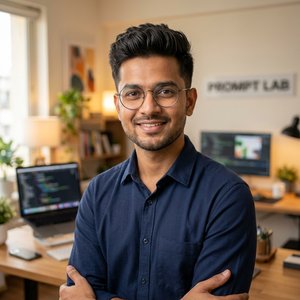
Sandip Barman has spent over eight years working in commercial photography, portraiture, and generative AI research. At The Prompt Deck, he tests, calibrates, and benchmarks prompt recipes across Midjourney, FLUX, and ChatGPT to help digital artists achieve authentic photographic realism without digital artificiality.